Porchlight › How to play › Backgammon
How to play Backgammon
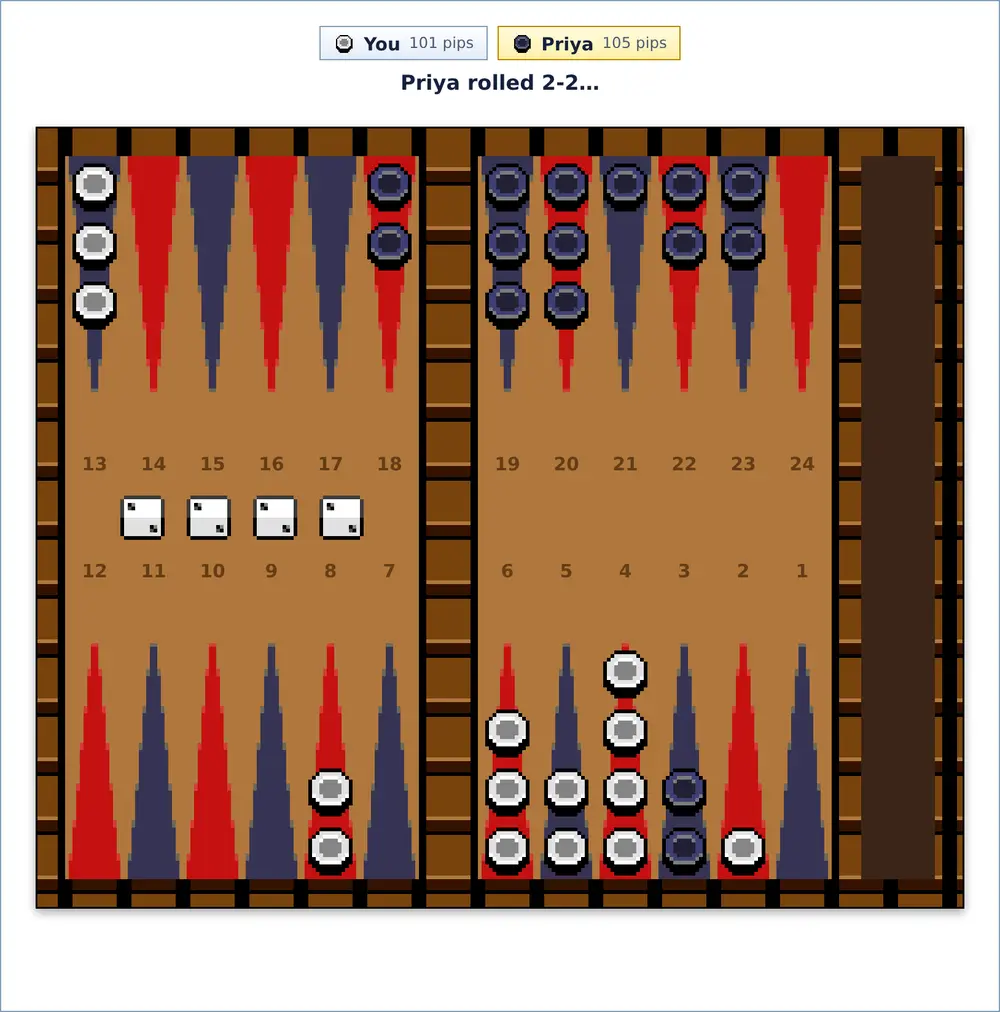
A race game for two players, played with dice. Move your checkers round the board and off it before your opponent does.
The aim
Bring all fifteen of your checkers into your home board, then bear them off. The first player to bear off all fifteen wins.
Setting up
The board has 24 points (the long triangles) in four quarters of six. The two players move in opposite directions, and your home board is the last quarter your checkers reach. One player is White and the other Black.
Each player starts with two checkers on their 24-point (the farthest from home), five on their 13-point, three on their 8-point and five on their 6-point.
To decide who starts, each player throws one die (thrown again if they match). The higher thrower moves first, using both dice as thrown.
Playing
From then on, two dice are thrown for you at the start of each turn.
- Each die moves one checker forward that many points. One checker can use both dice, or two checkers can use one die each.
- A double gives you four moves of that number.
- You can't land on a point holding two or more of your opponent's checkers.
- Landing on a point holding a single opposing checker hits it. The hit checker goes to the bar in the middle of the board.
- While you have a checker on the bar, you must bring it in before moving anything else. It enters your opponent's home board on the point matching one of your dice, if that point is open.
- You must use as many dice as you can. If you can use only one of two different dice, you must use the larger when that is possible.
- If you can't move at all, your turn is passed, and the board shows the roll you couldn't use.
Bearing off. Once all fifteen of your checkers are in your home board, a die removes a checker from the matching point. A die larger than any occupied point removes a checker from your highest occupied point. If one of your checkers is hit while you're bearing off, it must travel all the way home again before you can continue.
Scoring
Each game stands alone. The winner scores:
| Result | When | Points |
|---|---|---|
| Win | The loser has borne off at least one checker | 1 |
| Gammon | The loser has borne off none | 2 |
| Backgammon | A gammon where the loser still has a checker on the bar or in the winner's home board | 3 |
Ranked ratings count only the win or loss. There is no doubling cube.
Table options
| Option | Choices | Default |
|---|---|---|
| Computer player | Easy, Normal or Hard | Normal |
| Turn timer | Normal, Relaxed (twice as long), Quick (half as long) | Normal |
Ranked games always use the defaults.
On Porchlight
Your home board is always at the bottom right. Your checkers enter at the top right, travel left along the top, then right along the bottom.
- Checkers that can move are lit. Click one, then click a highlighted point. You can also click a point that one checker would reach using both dice.
- Click the bar to bring a checker in, and the tray on the right to bear off.
- Nothing is sent until you press Done. Undo takes back moves one at a time.
- Each player's pip count (the total distance their checkers still have to travel) is shown above the board.
- On a phone the board turns on its side, with Undo and Done above it.
Computer players. Easy judges positions with simple rules and plays loosely. Normal uses a program that trained itself by playing against itself. Hard uses the same program and also checks every roll you could throw next.
The turn timer. On a Normal timer you have 60 seconds per turn. If time runs out, the computer plays that turn for you. If it runs out again on your very next turn, you forfeit the game. You also forfeit if you leave, or if your connection drops and you don't come back within about a minute.
Tips
- Two or more checkers on a point are safe. Avoid leaving a single checker where it can easily be hit.
- Watch the pip counts. When you're well ahead, play safe and race. When you're behind, holding points deep in your opponent's side gives you chances to hit.