Porchlight › How to play › Riichi Mahjong
How to play Riichi Mahjong
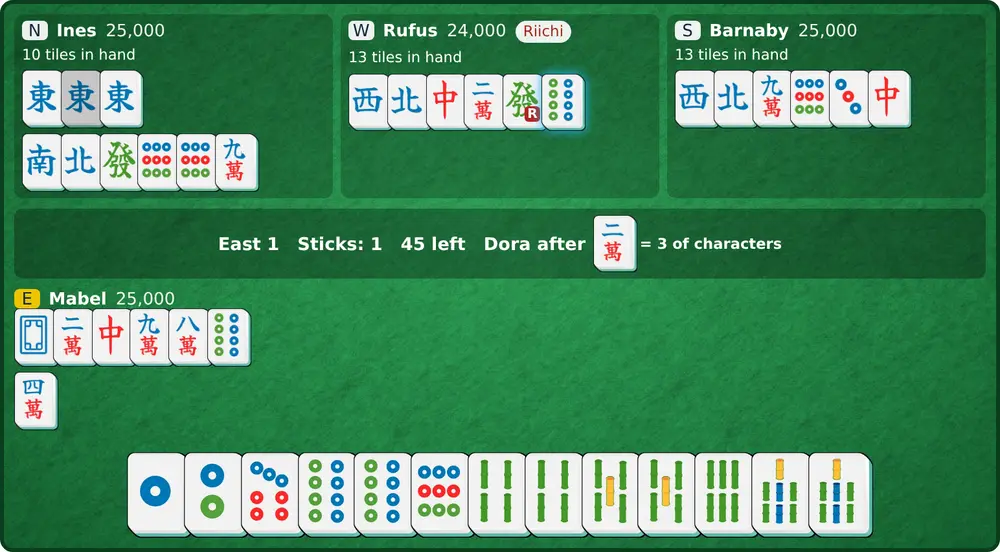
Japanese mahjong for four players. You draw and discard tiles to build a hand of four sets and a pair, and the first to finish a hand that is worth something wins it. It has more rules than most games here, so the table explains itself as you play: it says how far your hand is from ready, what you are waiting for, why a tile can't win for you, and how every score was added up.
The aim
Finish with the most points. Everyone starts with 25,000, and each hand moves points from the losers to the winner.
The tiles
There are 136 tiles, four of each of 34 kinds:
- Three suits, numbered 1 to 9: dots, bamboo and characters. The 1 of bamboo is drawn as a bird.
- Winds: East, South, West, North.
- Dragons: red, green, white.
One five in each suit is a red five. It plays as an ordinary five and adds to the score of a hand that wins with it.
If you don't read the characters, turn on Marks on the tiles: each character tile gets its number and each wind its letter.
A hand
A winning hand is four sets and a pair, 14 tiles in all. A set is either:
- a run: three in a row in one suit, like 4-5-6 of dots, or
- a triplet: three alike. Four alike can be declared as a kan, which counts as one set and gives you an extra tile.
Winds and dragons can't make runs. Two hands break the pattern: seven pairs, and thirteen orphans (one of every 1, 9, wind and dragon, plus a second of any of them).
A turn
Each player starts with 13 tiles. On your turn you draw one and discard one, which goes face up in front of you. Turns pass to the right-hand player: East, South, West, North.
After a discard, the others may take it:
- Chi: the player whose turn is next may take it to finish a run.
- Pon: anyone holding two alike may take it to make a triplet. Play then jumps to them.
- Kan: anyone holding three alike may take it to make four.
- Ron: anyone it would finish a winning hand for may take it and win.
A set made with someone's discard is laid face up, and your hand is then open. A hand with nothing called is closed. Open hands are quicker to finish and usually worth less, and they can't call riichi.
When a discard could be used by anyone, the game pauses while every other player answers. You are only shown buttons if you have a choice, and nobody can see who is choosing.
Drawing your own winning tile is tsumo: everyone pays. Winning on a discard is ron: the player who threw it pays for everyone.
You need a yaku
This is the rule that catches everyone. Four sets and a pair is not enough: the hand must have at least one yaku, a scoring pattern. Without one it can't win, however complete it looks. The table will tell you when this is what is stopping you.
The three yaku most hands are won with:
- Riichi. With a closed hand that is ready (one tile from winning), you may call riichi as you discard. You stake 1,000 points and your hand is locked: from then on you discard whatever you draw unless it wins. Riichi is a yaku by itself, so any closed, ready hand can win this way.
- All simples. A hand with no 1s, 9s, winds or dragons. It may be open.
- A set of dragons, of your own wind, or of the round's wind. It may be open.
The full list is at the foot of this page.
Furiten
You can't win on a discard if any tile that would finish your hand is among your own discards. You also can't win on a discard for the rest of the go-round after letting a winning tile go by (for the rest of the hand, if you are in riichi). You can always win by drawing the tile yourself. The table warns you when you are furiten.
Dora
One tile beside the wall is turned face up: the dora indicator. The tile that comes next after it (after a 9 comes the 1; after North comes East; red, white, green in a circle) is the dora, and every one of them in a winning hand adds to its score. Each kan turns up another indicator. A riichi winner also gets the tiles underneath the indicators.
Dora and red fives add to a hand's score but are not yaku: a hand with three dora and no yaku still can't win.
Scoring
A winning hand counts its han: one or more for each yaku, plus one for each dora and red five. It also counts fu, small points for the way it is built: triplets, a single-tile wait, winning by your own draw. Han and fu together give the payment, and han matter far more: each one roughly doubles it. From 5 han up the score is fixed:
| Han | Called | Non-dealer wins | Dealer wins |
|---|---|---|---|
| 5 (or 4 with 40 fu, 3 with 70 fu) | Mangan | 8,000 | 12,000 |
| 6 or 7 | Haneman | 12,000 | 18,000 |
| 8 to 10 | Baiman | 16,000 | 24,000 |
| 11 or 12 | Sanbaiman | 24,000 | 36,000 |
| 13 or more, or a yakuman hand | Yakuman | 32,000 | 48,000 |
You never have to work it out. After each hand the table lists the yaku, the han, and each piece of the fu sum.
The dealer (the East seat) wins and pays half as much again. On a tsumo by anyone else, the dealer pays twice what the other two do.
When nobody wins
If the wall runs out, the hand is a draw. Players whose hands are ready are paid 3,000 between them by those whose hands aren't. A player who discarded nothing but 1s, 9s, winds and dragons, none of them taken, is paid a mangan instead.
A hand is dealt again with no payment if a player asks for it with nine or more different 1s, 9s, winds and dragons in their opening hand, if the first four discards are the same wind, if all four players call riichi, or if four kans are declared by more than one player.
The deal, and the game
The dealer keeps the deal after winning, or after a draw if their hand was ready. Otherwise it passes to the right. Each hand the deal stays put adds a repeat, worth 300 extra to the next win. Riichi stakes stay on the table for the next winner.
A game is the East round: until the deal has gone once around the table. A table can choose East and South rounds for a game twice as long. If nobody has 30,000 points when the last deal passes, play goes on until someone does. The game ends at once if anyone drops below zero.
The rules in detail
- All simples may be open. Three red fives.
- If more than one player can win on the same discard, they all do. Stakes on the table and the repeat bonus go to the one nearest the discarder in turn order.
- A tile you have just called can't be discarded on that turn, nor the tile at the other end of the run it made.
- In riichi you may declare a concealed kan only with the tile you just drew, and only if it doesn't change what your hand waits for.
- A tile added to a pon to make a kan can be won on by anyone waiting for it.
- A hand of 13 han or more counts as a yakuman. Two different yakuman in one hand are both paid.
- 4 han with 30 fu is 7,700 (11,600 for the dealer), not rounded up to a mangan.
The yaku
"Closed only" means the hand must have nothing called. Where two values are given, the lower is for an open hand.
| Yaku | Japanese | Han | What it is |
|---|---|---|---|
| Riichi | riichi | 1 | You declared a ready, closed hand and staked 1,000 on it. |
| Double riichi | daburu riichi | 2 | Riichi on your very first discard, before anyone called. |
| One shot | ippatsu | 1 | You won within one go-round of calling riichi, with no calls in between. |
| Drawn win, closed hand | menzen tsumo | 1 | You drew the winning tile yourself with nothing called. |
| All runs | pinfu | 1 | Four runs, a pair that scores nothing, and a wait on either end of a run. Closed only. |
| All simples | tanyao | 1 | Only tiles from 2 to 8: no ones, nines, winds or dragons. |
| Twin runs | iipeikou | 1 | The same run twice in the same suit. Closed only. |
| Your wind | yakuhai | 1 | Three of your own seat's wind. |
| Round's wind | yakuhai | 1 | Three of the wind of the round. |
| White dragons | yakuhai | 1 | Three white dragons. |
| Green dragons | yakuhai | 1 | Three green dragons. |
| Red dragons | yakuhai | 1 | Three red dragons. |
| Win after a kan | rinshan kaihou | 1 | You won on the extra tile drawn after declaring a kan. |
| Robbing a kan | chankan | 1 | You won on the tile someone added to their pon to make a kan. |
| Last tile | haitei | 1 | You drew the winning tile as the very last tile of the wall. |
| Last discard | houtei | 1 | You won on the very last discard of the hand. |
| Seven pairs | chiitoitsu | 2 | Seven different pairs instead of four sets and a pair. |
| Three-suit run | sanshoku doujun | 2 (1 open) | The same run in all three suits. |
| Straight | ittsu | 2 (1 open) | 1-2-3, 4-5-6 and 7-8-9 in one suit. |
| Ends in every set | chanta | 2 (1 open) | Every set and the pair has a one, a nine, a wind or a dragon. |
| All triplets | toitoi | 2 | Four sets of three or four alike: no runs. |
| Three concealed triplets | sanankou | 2 | Three sets of three alike, all drawn yourself. |
| Three-suit triplets | sanshoku doukou | 2 | Three of the same number in all three suits. |
| Three kans | sankantsu | 2 | Three sets of four. |
| Little three dragons | shousangen | 2 | Two sets of dragons and a pair of the third. |
| All ends | honroutou | 2 | Nothing but ones, nines, winds and dragons. |
| Half flush | honitsu | 3 (2 open) | One suit, plus winds or dragons. |
| Ones and nines in every set | junchan | 3 (2 open) | Every set and the pair has a one or a nine, and there are no winds or dragons. |
| Two twin runs | ryanpeikou | 3 | Two different pairs of identical runs. Closed only. |
| Full flush | chinitsu | 6 (5 open) | One suit and nothing else. |
| Thirteen orphans | kokushi musou | Yakuman | One of every one, nine, wind and dragon, and a second of any of them. |
| Four concealed triplets | suuankou | Yakuman | Four sets of three alike, all drawn yourself. |
| Big three dragons | daisangen | Yakuman | A set of each of the three dragons. |
| Little four winds | shousuushii | Yakuman | Sets of three winds and a pair of the fourth. |
| Big four winds | daisuushii | Yakuman | A set of each of the four winds. |
| All honors | tsuuiisou | Yakuman | Nothing but winds and dragons. |
| All green | ryuuiisou | Yakuman | Only the all-green tiles: 2, 3, 4, 6 and 8 of bamboo and green dragons. |
| All ones and nines | chinroutou | Yakuman | Nothing but ones and nines. |
| Nine gates | chuuren poutou | Yakuman | 1-1-1-2-3-4-5-6-7-8-9-9-9 in one suit plus any one more of it. Closed only. |
| Four kans | suukantsu | Yakuman | Four sets of four. |
| Heavenly hand | tenhou | Yakuman | The dealer wins on the first draw. |
| Earthly hand | chiihou | Yakuman | A non-dealer wins on their first draw, before anyone called. |
On Porchlight
- Empty seats can be filled by computer players at three levels.
- The line under your hand always says where you stand: how many tiles from ready, what you are waiting for and how many of them are left unseen, and why you can't win on a tile when you can't.
- Tiles are drawn in your own tile set, chosen on the Customize page.