Porchlight › How to play › LexiGrid
How to play LexiGrid
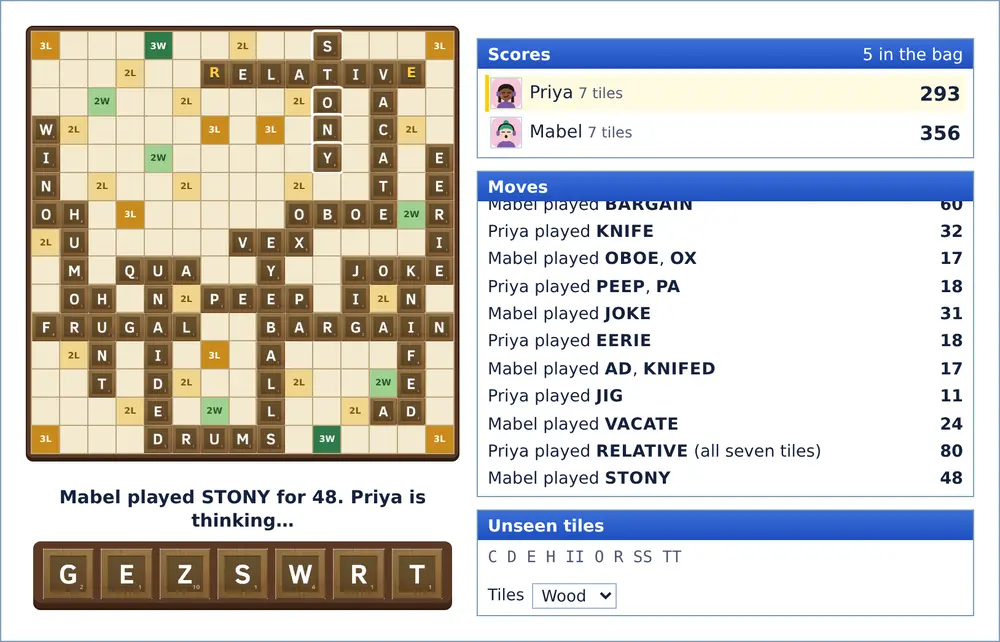
The crossword tile game, for two to four players: lay letter tiles on the board to make words that cross the ones already there.
The aim
Score the most points. Each word you make scores the points on its tiles, more on the colored squares.
Setting up
The bag holds 100 tiles: 98 letters and 2 blanks. Each player draws 7. A random player goes first.
| Letter | Points | Tiles |
|---|---|---|
| A E I L N O R S T U | 1 | A 9, E 12, I 8, L 4, N 6, O 7, R 6, S 5, T 6, U 4 |
| D G | 2 | D 4, G 3 |
| B C M P | 3 | 2 each |
| F H V W Y | 4 | H 3; F, V, W and Y 2 each |
| K | 5 | 1 |
| J X | 8 | 1 each |
| Q Z | 10 | 1 each |
| Blank | 0 | 2 |
A blank can stand for any letter. You choose the letter when you lay it, and it keeps that letter for the rest of the game. It scores nothing.
Your turn
Do one of these:
- Play a word. Lay one or more tiles in a single row or a single column. Together with any tiles already in that line, they must make one unbroken word, reading left to right or top to bottom. Every new word your tiles form across the line must be a word too.
- Trade. Put any number of your tiles back in the bag and draw the same number. You can only trade while the bag has 7 or more tiles. A trade scores nothing.
- Pass. Do nothing this turn.
The first word must cover the ★ in the middle and be at least two letters long. After that, every play must join onto the tiles on the board, by using one of them or by laying a tile next to one.
After you play, you draw back up to 7 tiles while the bag has any.
Words
Words are checked against the game's word list when you play. If any word you made isn't on it, the play is refused, nothing is lost, and you can try something else. You can try as many times as you like before your time runs out.
The list is ENABLE, a public-domain list of about 170,000 English words made for word games, plus newer everyday words it lacks (such as email, online and selfie) and a few two-letter words players expect (qi, za, ok, ew). It has no names or abbreviations, but plurals and verb endings count: cat, cats, catted. Slurs aren't on it. It also takes a couple of words you won't find in any dictionary, which you'll have to discover for yourself.
Scoring
Add up the points of every word you made this turn. For each word:
- Add the points of all its letters, old tiles included.
- A tile you just laid on 2L or 3L counts double or triple.
- If one of your new tiles is on 2W or 3W, the whole word counts double or triple. Two of them multiply together.
- A colored square only counts in the turn a tile is first laid on it. After that it's an ordinary square.
A tile that makes words both across and down counts in both, colored square and all.
All seven. Using all 7 of your tiles in one turn earns 40 bonus points.
The end of the game
The game ends when:
- the bag is empty and a player uses their last tile. That player gains the points left on everyone else's tiles, and each other player loses the points on their own; or
- every player has passed or traded twice in a row. Everyone loses the points left on their own tiles.
The highest score wins. Scores can tie.
Table options
| Option | Choices | Default |
|---|---|---|
| Tiles | 100 (a full game), or 50 (a shorter game) | 100 |
| Computer players | Easy, Normal or Hard | Normal |
| Turn timer | Normal, Relaxed (twice as long), Quick (half as long) | Normal |
The 50-tile game draws 50 tiles at random from the full set before the start, so which letters are in it isn't known.
On Porchlight
- Drag a tile from your rack to a square. Or tap a tile, then tap the square.
- Or click a square and type. Letters fill the squares going right. Click the same square again to type downward instead (the arrow in the corner shows which way). Backspace takes back the last letter, and Enter plays.
- Tap a tile you've laid to take it back. Recall takes them all back. Drag tiles within your rack to rearrange them, or press Shuffle.
- The Play button shows what your tiles would score, and the number also appears beside your last tile.
- Trade lets you pick tiles to send back. Pass asks you to press it a second time.
- You can lay tiles while others take their turns, to plan ahead. If someone else plays on a square you've used, that tile comes back to your rack.
- Moves lists every turn. Unseen tiles shows the tiles you haven't seen yet: those in the bag and on the other players' racks.
- You can choose from three tile styles.
Computer players. Easy plays everyday words of up to six letters and settles for an average score. Normal knows more words and plays a good move, though not always the best. Hard knows every word on the list, plays for the most points, and thinks about which tiles it keeps. None of them plays a word with a swear in it. Play with bots seats you against one computer player; at a table, the host can seat more.
The turn timer. On a Normal timer you have 2 minutes a turn. If time runs out, your turn is passed. If it runs out again on your very next turn, you're out of the game. With three or four players, a computer player takes your seat and you're placed last; in a two-player game, you forfeit. The same happens if you leave, or if your connection drops and you don't come back within about a minute.
Tips
- The two-letter words are what make room on a crowded board: qi, za, xu, jo, ax, ex, ox, xi.
- Laying a word alongside another, so every tile makes a short word down as well, can score more than one long word.
- An S or a blank can add to a word on the board while making a new one. Use them for a big score rather than a small one.
- Hold on to good tiles (E, R, S, T, A, the blank) and trade away clumsy ones (two Vs, a Q without a U) if the bag has enough.
- Think twice before a play that lets the next player reach a 3W square.