Porchlight › How to play › Checkers
How to play Checkers
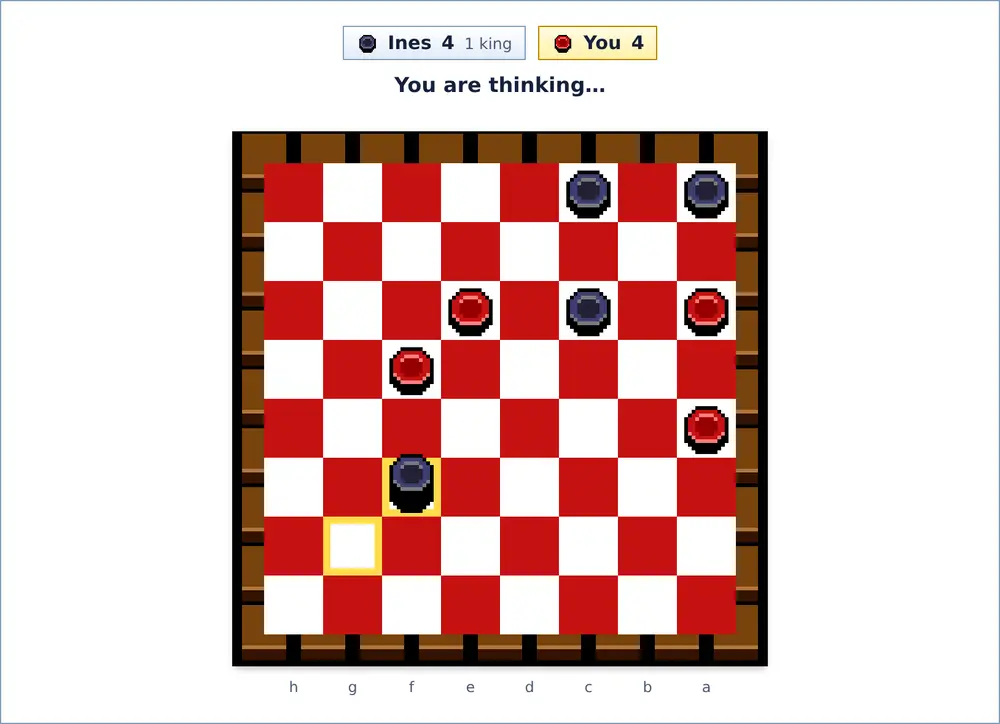
A board game for two players, played with diagonal moves and jumps. Porchlight uses the American rules, also known as English draughts.
The aim
Leave your opponent with no legal move. Usually that means capturing all of their pieces, but blocking every piece they have left wins too.
Setting up
The board is 8 × 8, and all play is on the white squares; the red squares are never used. Each player starts with 12 pieces on the three rows nearest them.
One player is Black and the other is Red. Black always moves first. Who plays Black is drawn at random each game, so the host doesn't always get the first move in a rematch.
Playing
On your turn, move one piece.
- Ordinary pieces move one square diagonally forward, onto an empty square.
- Kings move one square diagonally in any direction.
- Jumping. If an enemy piece is diagonally next to one of yours and the square directly beyond it is empty, you can jump over it and remove it from the board. Ordinary pieces jump forward only; kings jump in any direction.
- Jumping is compulsory. If you can jump, you must. If more than one jump is available, you choose which one.
- Multiple jumps. After a jump, if the same piece can jump again, it must keep going until it can't. You don't have to choose the sequence that captures the most pieces, but once you begin a sequence you must finish it.
- Crowning. An ordinary piece that reaches the far row becomes a king. Crowning ends your move, even if the new king could jump at once.
Winning
You win when your opponent has no legal move on their turn, either because they have no pieces left or because every piece they have is blocked.
Draws. The game is a draw if each player makes 40 moves in a row with no capture and no ordinary piece moving. This usually means only kings are left, circling without progress.
Either player can also offer a draw at any time, even during the other player's turn. The other player can accept or decline, and making a move declines it. You can offer once per move; if your offer is declined, you can offer again after the next move.
Table options
| Option | Choices | Default |
|---|---|---|
| Computer player | Easy, Normal or Hard | Normal |
| Turn timer | Normal, Relaxed (twice as long), Quick (half as long) | Normal |
The computer level only matters when a computer player is at the table. Ranked games always use the defaults.
On Porchlight
Your pieces are always at the bottom of the board. The bar above the board shows how many pieces each player has left, and how many of them are kings.
- Pieces that can move are lit. Click one to pick it up, then click the square it should land on.
- A king is drawn as two checkers stacked, as you would crown one on a real board.
- For a multiple jump, click each landing square in turn. If only one jump sequence ends on a particular square, you can click that final square straight away.
- The status line reads "You must jump" when a jump is available, and "Keep jumping" partway through a sequence.
- Clicking anywhere that isn't a legal move clears your selection. Escape does the same.
- With a keyboard, the arrow keys move around the board and Enter or Space selects a square.
- Offer a draw is above the board. When your opponent offers, Accept and Decline buttons appear in its place.
Computer players. Easy looks about two moves ahead and plays loosely. Normal looks four moves ahead. Hard searches as deep as its budget allows, usually six to eight moves.
The turn timer. On a Normal timer you have 45 seconds per move. If time runs out, the computer makes one move for you. If it runs out again on your very next turn, you forfeit the game. You also forfeit if you leave, or if your connection drops and you don't come back within about a minute.
Tips
- Because jumps are compulsory, you can sacrifice a piece to pull an enemy piece onto a square where you can jump it back.
- Keep your back row filled as long as you can. It stops your opponent from crowning.
- A king is worth far more than an ordinary piece. Getting one early often decides the game.
- Before each move, check which jumps you will be forced into on your next turn.