Porchlight › How to play › Liar's Dice
How to play Liar's Dice
A bluffing dice game for two to six players. Everyone rolls five dice in secret, then players bid on how many of a face are showing under all the cups together.
The aim
Keep your dice. Each time you're caught out, you lose one. The last player with any dice left wins.
Setting up
Everyone starts with five dice. At the start of each round, every player still in rolls their dice in secret and sees only their own. The first player to bid is drawn at random.
Playing
Players take turns round the table. A bid names a quantity and a face: "four fives" claims there are at least four fives among everyone's dice.
The opener makes any bid. Each player after that must either raise the bid or challenge it.
Raising
A raise is either:
- more dice, of any face ("four fives" to "five twos"), or
- the same number of dice, of a higher face ("four fives" to "four sixes").
You can't bid more dice than there are in play.
Wild ones
By default, ones are wild: every one counts toward whatever face is bid. This changes the rules for bids on ones:
- Nobody may open the round on ones.
- To switch to ones, you may halve the quantity, rounding up. After "seven fours", "four ones" is a legal raise.
- To switch away from ones, you need more than double the quantity. After "three ones", the next bid must be at least seven of another face.
- A bid on ones counts only the ones.
Challenging
Instead of raising, you can challenge the last bid:
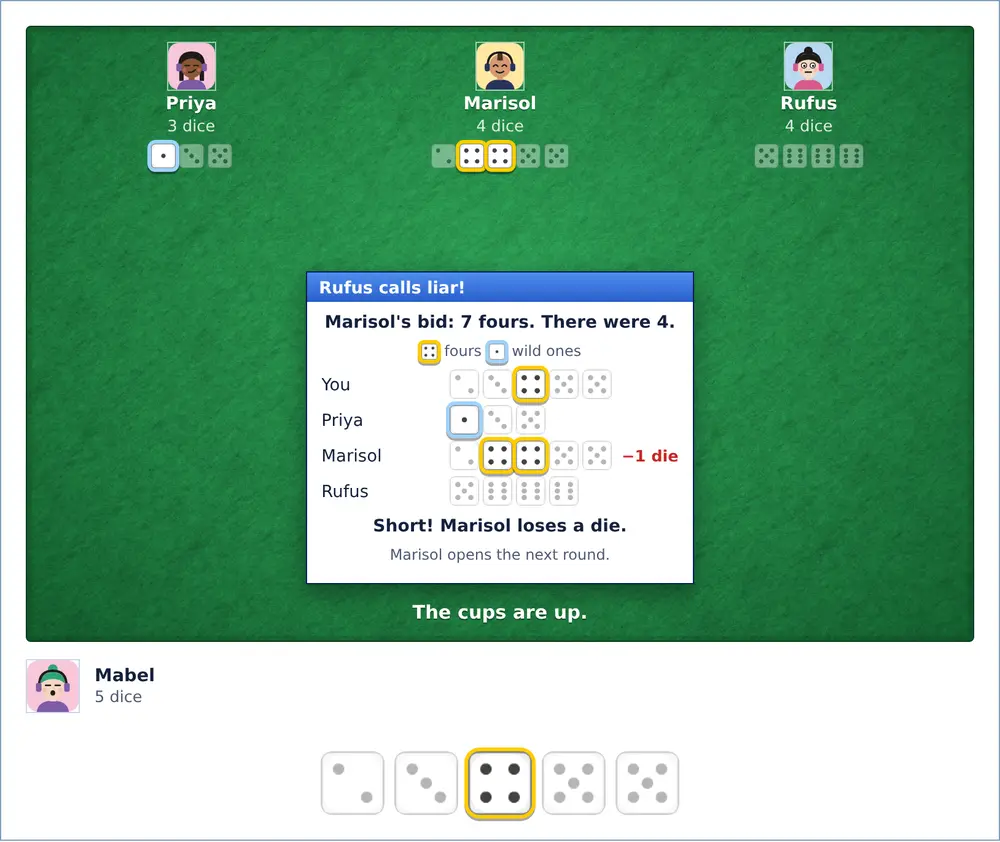
- Liar! You claim the bid is too high. All the cups are lifted. If there are at least as many as were bid, you lose a die. If there are fewer, the bidder loses a die.
- Spot on! You claim the bid is exactly right. If it is, everyone else loses a die. If it isn't, you lose one.
The next round
The player who lost a die opens the next round. After a spot-on call, the caller opens, whether they were right or wrong. If the opener has no dice left, the next player along opens.
Winning
When you lose your last die, you're out. Players are placed in the order they went out. Players knocked out by the same call share a place.
Table options
| Option | Choices | Default |
|---|---|---|
| Ones | Wild, or Not wild | Wild |
| Spot on | Right: everyone else loses a die; Right: you win a die back; or Not allowed | Everyone else loses a die |
| Palifico | Off or On | Off |
| Computer players | Easy, Normal or Hard | Normal |
| Turn timer | Normal, Relaxed (twice as long), Quick (half as long) | Normal |
- Ones not wild: ones are an ordinary face, the lowest, and the special rules for bidding on them don't apply.
- You win a die back: a correct spot-on call gives the caller a die back (up to five) instead of costing everyone else one.
- Palifico: the first time a player drops to one die, they open the next round under special rules: ones aren't wild, the opener may bid any face (ones included), and every raise must keep that face and increase the quantity. Each player gets one palifico round, and there are none once only two players are left.
Ranked games always use the defaults.
On Porchlight
- To bid, click a face, set the quantity with − and +, then press Bid. The quantity starts at the lowest legal raise for that face.
- A line under the bid picker shows how many of that face you hold, wild ones included.
- Press Liar! or Spot on! to challenge.
- Keys: 1 to 6 choose a face, ↑ and ↓ (or + and −) change the quantity, Enter bids, L calls liar, S calls spot on.
After a challenge, all the dice are shown, with the ones that counted lit. They stay up for 9 seconds on a Normal timer, or until everyone still in presses Next round.
On a Normal timer you have 30 seconds for each bid or call. If time runs out, the computer moves for you. If it runs out twice in a row, you're out of the game: a computer player takes your seat and you're placed last (in a two-player game, you forfeit). The same happens if you leave, or if your connection drops and you don't come back within about a minute.
The host can fill empty seats with computer players. Play with bots seats you with three.
Tips
- On average, any face shows on one die in six, or one in three with wild ones. Add what you hold yourself to estimate the total.
- Bids give information. A player who raises on sixes probably holds some.
- Low bids are usually true. Calling liar too early costs dice.