Porchlight › How to play › Spades
How to play Spades
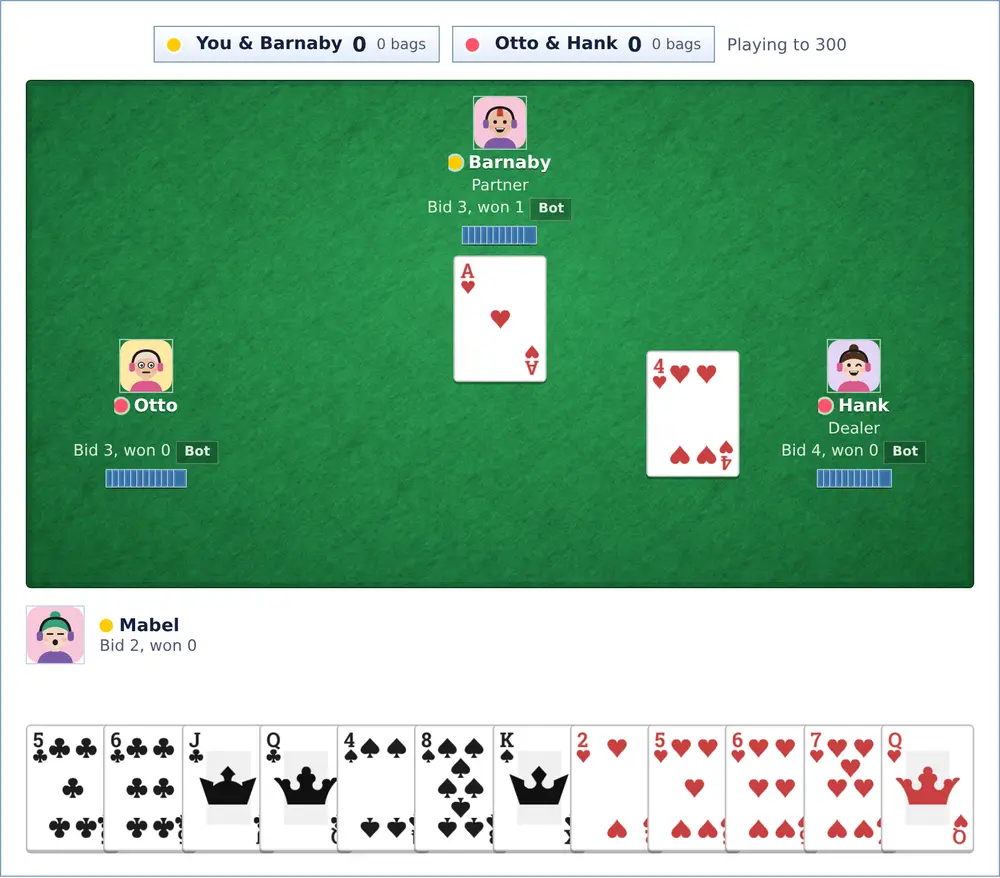
A trick-taking card game for four players in two partnerships. Your partner sits across the table from you.
The aim
Each hand, you and your partner bid how many tricks you'll win between you, then try to win at least that many. Spades are always trumps. The first partnership to reach the target score wins.
Setting up
The first dealer is chosen at random, and the deal moves one seat clockwise each hand. The whole deck is dealt, 13 cards each. Aces are high.
Bidding. Starting with the player left of the dealer, each player bids once: the number of tricks they expect to win, from 1 to 13. A player may instead bid Nil, promising to win no tricks at all. There is no Blind Nil.
A partnership's contract is its two bids added together. A Nil bid adds nothing.
Playing
The player left of the dealer leads the first trick. Play goes clockwise.
- You must follow suit if you can. If you can't, play any card, including a spade.
- The highest spade played wins the trick. If no spade was played, the highest card of the suit led wins.
- The winner of a trick leads the next one.
Leading spades. You can't lead a spade until a spade has been played on an earlier trick ("spades are broken"), unless spades are all you hold.
Scoring
Partners score together at the end of each hand.
| Result | Points |
|---|---|
| Contract made | 10 per trick bid |
| Each trick over the contract (a "bag") | 1 |
| Every 10 bags collected | minus 100 |
| Contract missed | minus 10 per trick bid |
| Nil made | 100 |
| Nil failed | minus 100 |
- Tricks won by a Nil bidder count toward the partnership's contract, even though the Nil itself fails.
- Bags count only when the contract is made. They carry over from hand to hand; each time the partnership's total reaches 10, it loses 100 points and the count drops by 10.
- If both partners bid Nil, every trick the partnership takes is a bag.
Winning
After each hand, the game ends if a partnership has reached the target score, or has fallen to minus 200 or below. The higher score wins. If the two scores are exactly equal, play continues.
Table options
| Option | Choices | Default |
|---|---|---|
| Play to | 200, 300 or 500 points | 300 |
| Nil bids | Allowed or Not allowed | Allowed |
| Turn timer | Normal, Relaxed (twice as long), Quick (half as long) | Normal |
With Nil bids not allowed, every bid must be at least 1. Ranked games always use the defaults.
On Porchlight
You sit at the bottom, your partner across from you, and your opponents to your left and right.
- Bidding. Click a number (or Nil) below the table, then press Bid to confirm.
- Playing. Cards you can legally play are lit. Click one to play it. The arrow keys move between cards.
- Each seat shows its bid and the tricks it has won. The scoreboard shows both partnerships' scores and bags.
On a Normal timer you have 30 seconds to bid and 25 seconds to play a card. If time runs out, the computer plays for you. If it runs out twice in a row, you're out of the game: a computer player takes your seat and you're placed last. The same happens if you leave, or if your connection drops and you don't come back within about a minute.
The host can fill empty seats with computer players. Spades has one computer level.
Tips
- Count your sure tricks before bidding: aces, well-guarded kings, high spades, and short side suits you can trump.
- Once your contract is safe, try to lose the tricks you don't need. Bags add up.
- When your partner bids Nil, play high to win the tricks they must avoid.
- When an opponent bids Nil, lead low cards to force them to win a trick.