Porchlight › How to play › Dominoes
How to play Dominoes
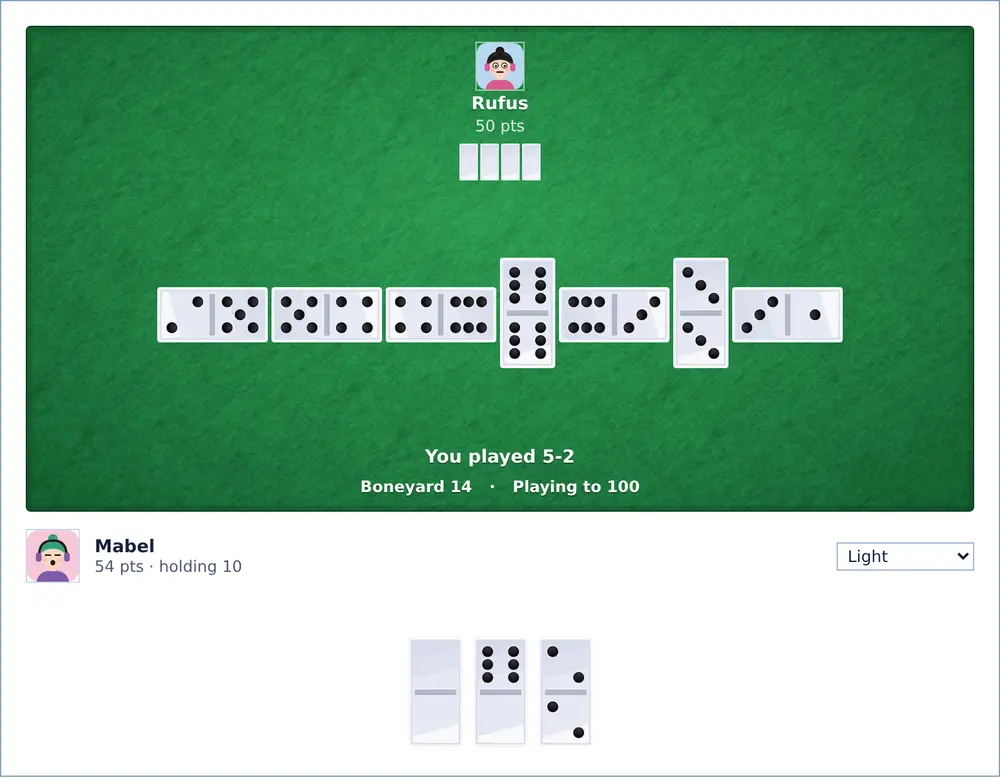
The tile-matching game, played with a double-six set, for two to four players.
The aim
Score points by playing out your tiles before the others, and be the first to reach the target score.
Setting up
The set has 28 tiles, from 0-0 up to 6-6. With two players, each gets 7 tiles; with three or four, each gets 5. The rest stay face down in the boneyard.
Who opens. In the first hand, the player holding the highest double must open with it. If nobody has a double, the heaviest tile opens. In later hands, the winner of the last hand opens with any tile. If a hand was blocked with a tie, the player after that hand's opener goes first.
Playing
On your turn, play a tile onto either open end of the line. The number on the tile must match the number at that end. If a tile fits both ends, you choose which.
The line only ever has two ends. A double is laid across the line, but doesn't open any extra ends.
Draw (the default)
If none of your tiles fit, draw from the boneyard until you get one that fits, then play it. If the boneyard is empty, you pass. You can't draw or pass while you have a tile that fits.
Block
There is no drawing. If none of your tiles fit, you pass.
All Fives
Played with the Draw rules, plus extra points during the hand. After you lay a tile, add up the numbers on the two open ends. If the total is a multiple of five, you score that many points at once. A double on an end counts both its halves, and when only the first tile is down, both its ends count. The full count is scored: ends adding up to 15 earn 15 points.
Scoring
Going out. When you play your last tile, you score the total pips (spots) left in all the other players' hands. In All Fives, the total is rounded to the nearest five.
A blocked hand. If every player passes in turn, the hand is blocked. The player holding the fewest pips scores the total pips in everyone else's hands (the full total, not the difference). If two or more players tie for fewest, nobody scores.
Winning
When a hand ends with a player at or past the target score, that player wins. In All Fives, the game ends the moment anyone reaches the target, even in the middle of a hand.
Table options
| Option | Choices | Default |
|---|---|---|
| Game | Draw, Block or All Fives | Draw |
| Play to | 50, 100 or 200 points | 50 |
| Computer players | Easy, Normal or Hard | Normal |
| Turn timer | Normal, Relaxed (twice as long), Quick (half as long) | Normal |
Ranked games always use the defaults.
On Porchlight
- Tiles that fit are lit. Click one to play it.
- If it fits both ends, choose an end with the buttons that appear, or click the lit end of the line. Cancel puts the tile back.
- Draw and Pass appear only when you have nothing to play. One click on Draw keeps drawing until something fits.
- Each player's score is shown under their name, with the pips you're holding under yours. The table shows how many tiles are in the boneyard and, in All Fives, the current total of the ends.
- You can choose from five tile styles.
After each hand, press Next hand. The next hand starts when everyone has pressed it, or after 20 seconds on a Normal timer.
Computer players. Easy plays any tile that fits. Normal sheds its heaviest tiles first, and in All Fives takes the most points. Hard tries out guesses at the hidden tiles and plays whatever does best on average. Play with bots seats you against one computer player; at a table, the host can seat more.
The turn timer. On a Normal timer you have 25 seconds per turn. If time runs out, the computer plays that turn for you. If it runs out again on your very next turn, you're out of the game. With three or four players, a computer player takes your seat and you're placed last; in a two-player game, you forfeit. The same happens if you leave, or if your connection drops and you don't come back within about a minute.
Tips
- In Draw and Block, play heavy tiles early. If someone else goes out, every pip you hold counts for them.
- When a player passes, they hold neither of the numbers that were on the ends. Playing to those numbers again can shut them out.
- In All Fives, check the ends before you play. Setting up a big count next turn can be worth more than a small score now.