Porchlight › How to play › Rubble Rousers
How to play Rubble Rousers
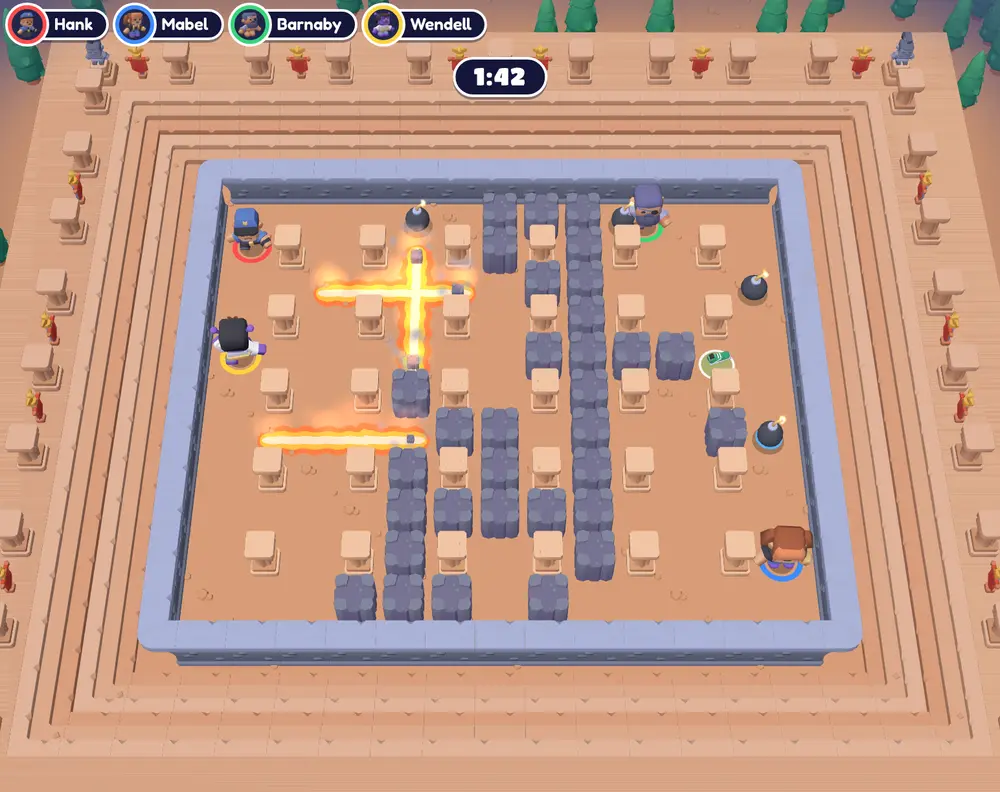
A real-time battle game for two to eight players. Everyone is in one walled arena full of blocks. Lay bombs to blast a way through and catch the others in the blasts.
The aim
Be the last one standing. A bomber caught in a blast is out for the round, and the last bomber left wins it. The first to win enough rounds wins the match.
Before the first round
Everyone picks a character, and the music they'd like to hear. Click or tap a character, or move to it with the arrow keys or a gamepad, and press Ready (or Space, or the gamepad's bomb button). There are twenty-one, and no two players can have the same one: the first to press Ready has it, and it dims for everyone else. A dot on a character shows it is someone's; a ring shows someone is looking at it. The round starts as soon as everyone is ready, and after twenty seconds either way: anyone still looking gets the character they were on, or another if it has gone. Computer players take what's left.
The character you chose is the one you start on next time. Characters are only looks: they all play the same. Music A, B and C play as you pick them, and the choice is yours alone.
The arena
The arena is a grid of squares inside a wall. Stone pillars stand on every other square and never break. Most of the other squares start with a block on them, which a blast destroys. Everyone starts in a clear spot of their own.
Two to four players play on the small arena, and five to eight on the large one.
Moving and bombing
| Keys | What they do |
|---|---|
| Arrow keys or W A S D | Move. |
| Space or Z | Lay a bomb on the square you're standing on. |
| X or Shift | The action button: see Kick and Trigger below, and the wall. |
On a touch screen there is a pad under your left thumb and a BOMB button under your right. A smaller ACT button appears above it when there's something for it to do. While you play, the game fills the screen; the ☰ button leaves that view for the chat and Resign, and Back to the game returns to it. A gamepad works too: the d-pad or left stick moves, the bottom button lays a bomb, and the right button is the action button.
Bombers walk along the lanes between the pillars. Pushing into the edge of a pillar near a lane slides you into it, so you don't have to turn corners exactly. You can walk off a bomb you've just laid, but not back onto it.
Bombs and blasts
- A bomb goes off 2.5 seconds after it's laid.
- Its blast runs out in a plus shape, two squares each way to start with. It stops at a pillar, and destroys the first block it meets in each direction. It burns for half a second, and anyone it touches in that time is out, including whoever laid it.
- A blast that reaches another bomb sets that bomb off straight away, so bombs go off in chains.
- A blast that reaches a power-up lying on the floor destroys it.
You start each round able to have one bomb out at a time.
Power-ups
About a third of the blocks hide a power-up. Walk over one to take it.
| Power-up | What it does |
|---|---|
| Extra bomb | One more bomb out at a time, up to 8. |
| Longer blast | Your blasts reach a square further, up to 8. |
| Speed | You walk faster, up to five times. |
| Kick | Walk into a bomb to send it sliding until it reaches something. The action button stops the bombs you kicked. A kicked bomb can't go off while it slides, or until 0.8 seconds after it stops. |
| Trigger | Your bombs don't go off by themselves. The action button lights the oldest one, which goes off 0.6 seconds later. If you go out, the ones still waiting go off like ordinary bombs. A waiting bomb has a red band. |
| Pierce | Your blasts go through blocks, burning every one they cross. A piercing bomb has a blue band. |
| Max blast | Your blasts reach as far as the arena allows. Rare. |
| Hex | Rare, with a purple rim. 0.8 seconds after you take it, something goes wrong for ten seconds: you're slow, or too fast, your fuses are short, you can't lay bombs, you lay them whether you want to or not, or your controls are reversed. Touch another bomber to hand it on for the time it has left. Whoever has one has black smoke coming off them, so you can see who to keep away from. |
What your own bomber is carrying, and any hex, shows under the clock.
When a bomber goes out, up to six of the power-ups they held drop onto free squares around the arena for anyone to take. The rarer ones go first. A hex never drops, and nothing drops once sudden death has begun.
When you're out
A table can choose what happens to bombers who are out:
- Peanut Gallery (the default with five or more players): two seconds after you go out, you climb onto the arena's wall. Walk along it, hold the bomb button to wind up a throw and let go to throw a bomb into the arena. A tap lands it one square in; every quarter second you hold adds a square, up to five. A thrown bomb is in the air for about half a second, goes off 1.5 seconds after it lands, and its blast reaches two squares. It can't land on a block or another bomb, so it bounces on past them. After a bomb, your next throw is ready three seconds later; a bomb in your hands means it's ready.
- Trading Places: the same, and whoever's thrown bomb catches a bomber in its own blast jumps back into the arena in their place, with what a bomber starts a round with. Nothing can hurt them for 1.5 seconds after they land. The one they caught goes up onto the wall. Only the thrown bomb's own blast counts, not a blast it sets off, and nobody comes back once sudden death has begun.
- Just watch: nobody goes up onto the wall.
Whenever you're on the wall, the action button throws a lump of rubble the same way the bomb button throws a bomb. Where it lands it sets into a block after 0.8 seconds, unless someone is standing there, a bomb or power-up is lying there, or a blast is burning there; then it just breaks up. Rubble never hurts anyone. The next throw after rubble is ready five seconds later.
On the wall, without Trading Places, you can't win the round, but you can still decide who does.
Sudden death
When the round's clock runs out, the floor starts falling away, a whole ring of squares at a time, from the wall inward. A ring falls every five seconds. For its last two seconds it shows red cracks and trembles; then it drops, with everything on it, and anyone standing on it is out. Head for the middle.
Winning
The last bomber standing wins the round. In teams, the last team with anyone left wins it. If the last ones go out at the same moment, or the floor takes them together, the round is a draw and nobody scores.
The first to win the set number of rounds wins the match. If draws drag it on, it stops after a fixed number of rounds, and whoever won the most rounds places highest. Players with the same number share a place.
Teams
With two teams, a table shows its seats as Red and Blue: sit on the side you want. A table can't start with nobody on one side. Your team's rings are its color, and the stars are the team's. A team-mate's blast hurts you like anyone's, so mind where your friends are standing. On the wall you're still on your team; with Trading Places, only catching someone from the other team brings you back.
Leaving, and dropped connections
If your connection drops, your bomber stands still until you come back. You have a minute. In a match of two, leaving (or not coming back) gives the match up. With three or more, the computer plays your bomber on, and you're placed last.
Table options
- First to: 1, 2 (the default), 3 or 5 rounds.
- Round length: 1:30, 2:00 (the default) or 3:00 before sudden death.
- When out: Peanut Gallery with five or more players (the default), Peanut Gallery always, Trading Places, or just watch.
- Arena: Square One (the plain arena, the default), Cutting Corners (the corners cut away, leaving four arms round a middle), or House Divided (two courts with a solid divider between them, and gates through it that start blocked).
- Sides: everyone for themselves (the default) or two teams.
- Computer players: easy (the default), normal or hard.
- Hexes: in play (the default) or left out.
Ranked games are one-on-one with the default options, so nobody goes up onto the wall, and any computer player standing in is normal.